
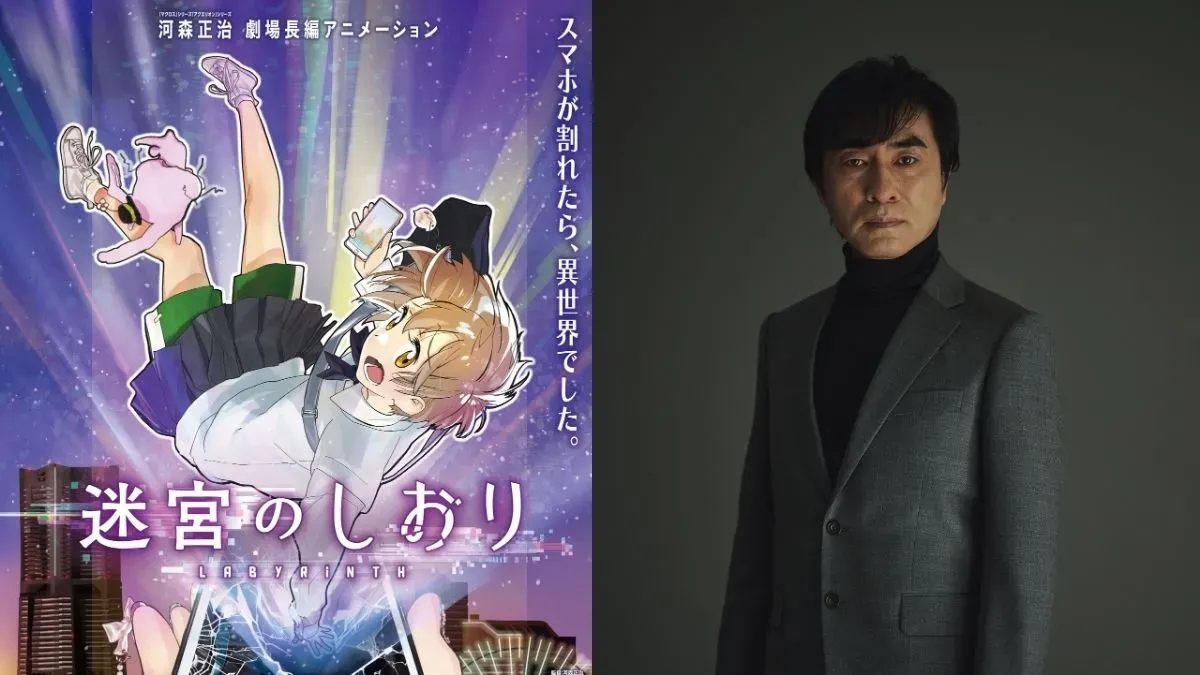
GosuAnime interviewed acclaimed Japanese animation creator and producer Shoji Kawamori about his upcoming animated feature film, Labyrinth.
Anyone who’s been a fan of the mecha genre in anime knows who Shoji Kawamori is. Rising to acclaim in the 1980s with his original franchise Macross, Kawamori also laid the foundation for various titles in the genre, like the Aquarion series, Eureka Seven, and The Vision of Escaflowne to name a few.
Kawamori is nothing short of a trailblazer–his vision for the mecha genre gave way to innovative concepts that significantly impacted popular culture, both in his native country of Japan and internationally. The idea of transforming mecha alone gave way to iconic characters like Optimus Prime from Transformers, which was originally a rebrand of Kawamori’s Diaclone toy line from Takara Toys.
Not only that, Kawamori innovated how mecha anime was written. Instead of focusing on the conflicts of combatants, like in Gundam, he pivoted to highlighting the experiences of non-combatant civilians victimised by conflict. His work led to the creation of the very first virtual idol, Lynn Minmay in Macross, which became the template for popular virtual idols like Hatsune Miku and Kizuna AI.
With such a long and celebrated career behind him, Kawamori has yet to show signs of slowing down. GosuAnime had the chance to sit down and talk with him during Anime Festival Asia Singapore 2025, about his new project: the upcoming sci-fi anime film “Labyrinth”, a film that marries his vision of technology and the future with today’s cultural moment.
What is Labyrinth all about?
Announced in July 2025, Labyrinth (Meikyu no Shiori) is Kawamori’s first feature-length anime film not based on any existing franchise.
The film follows a high school girl named Shiori Maezawa, who one day suddenly wakes up to find her smartphone broken. Not only that, she finds herself in a deserted, alternate-world Yokohama.
The mystery doesn’t end there–Shiori also discovers a photo of herself that she doesn’t recognise on her social media. Who could have taken that photo, and what is going on? Shiori finds herself trapped within the labyrinth of her smartphone, and must find a way to escape, one way or another.
What makes Labyrinth different from previous Kawamori titles?
Although Kawamori has almost always worked with original settings in his repertoire of titles, Labyrinth takes a different approach by grounding itself in the real Japanese city of Yokohama. For Kawamori, creating a subconscious, alternate Yokohama still draws upon his earlier experiences in the industry.
“The process of creating an original world is something I carried strongly into Labyrinth as well,” Kawamori stated when asked how his previous works influenced the film. “That approach becomes very useful when the story is set in the real city of Yokohama.”
Kawamori also credited his earlier works for informing the way he constructed the alternate-reality Yokohama, which he says “really helped a lot” in portraying a world where the smartphone is connected directly to the psyche.
When it comes to the focus on smartphones as this all-encompassing tech in the film, Kawamori said that he conceived the idea for Labyrinth with his own experiences with his smartphone.
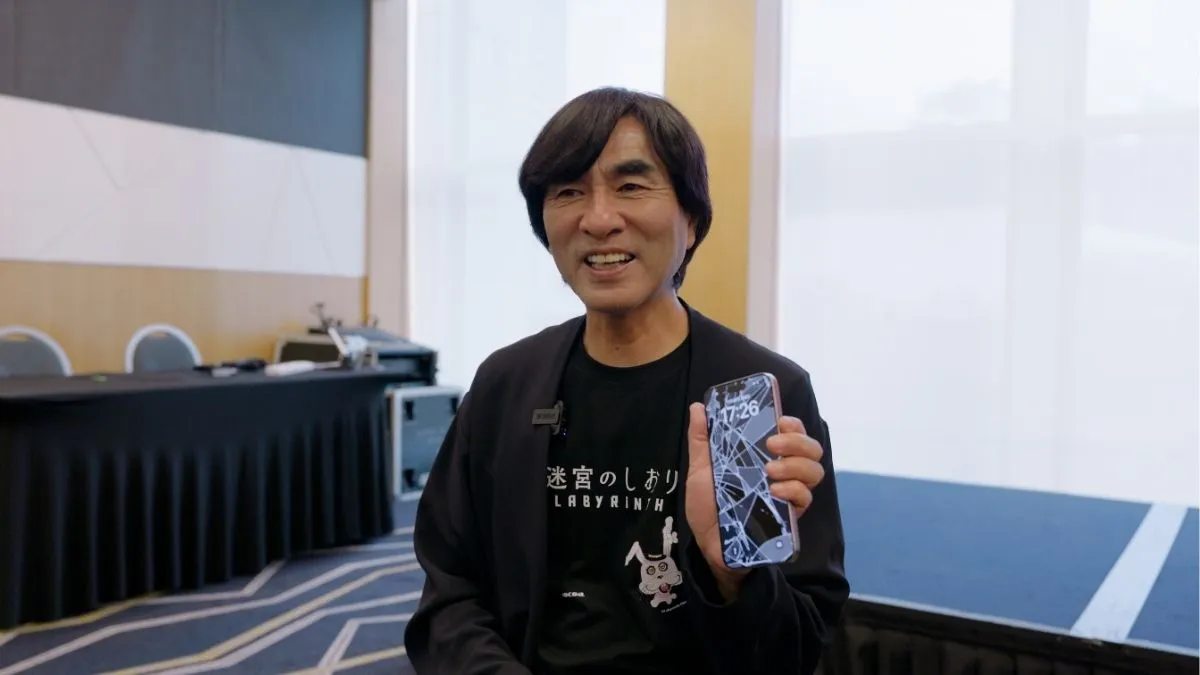
“I would sometimes crack my smartphone,” he said while holding up his phone with a smile, showing a cracked wallpaper on his lock screen, “or lose it, or forget it somewhere and then desperately search for it. Whenever that happened, I was struck by how inconvenient life becomes without a smartphone.”
A realisation dawned on Kawamori that his smartphone held important information about himself–his personal data, his search history, his messages, even his photos, which he described as “enormous data” about himself.
“It felt almost like another ‘me’, a kind of copy or extension of my own being. So when the screen cracked, it felt as if I had broken.”
Kawamori likened his smartphone to himself, further stating: “When I misplaced it, I felt like I had been left behind somewhere.”
To Kawamori, this idea seemed perfect as a theme for a modern film, inspiring him to make Labyrinth as a movie about a smartphone.
As he further fleshed out the concept for Labyrinth, Kawamori recounted how he looked into the device and its functions, deducing it as “the most extraordinary thing”, simply because its multitudes of functions, encased in a small metal body, was akin to a “super-machine” in his eyes. It had the ability to “transcend time and space”, making it a device that is extremely personal, yet “connected to the whole world.”
“In that sense, creating Labyrinth wasn’t so different for me from depicting a super robot. But instead of only a pilot controlling it, now everyone in modern society holds a long-axis super-machine in their hands.”
Although Kawamori thought highly of the smartphone and its various futuristic elements, a machine he stated didn’t even exist in his youth, he also acknowledges that the convenience of this tiny “long-axis super machine” can be misused.
“Even by casually posting one hurtful comment–someone on the other side of the world might be deeply wounded,” Kawamori mused as we discussed modern digital culture, “perhaps to the point of feeling they can’t go on living. That’s the world we live in now.”
To Kawamori, the small size of a smartphone is something he found meaningful and worth depicting in Labyrinth, “people forget it’s actually more powerful than some super robots,” he said while looking at his own smartphone.
“That gap–the tiny size versus its immense power–was something I found very meaningful and worth depicting in this film.”
The maze within your smartphone
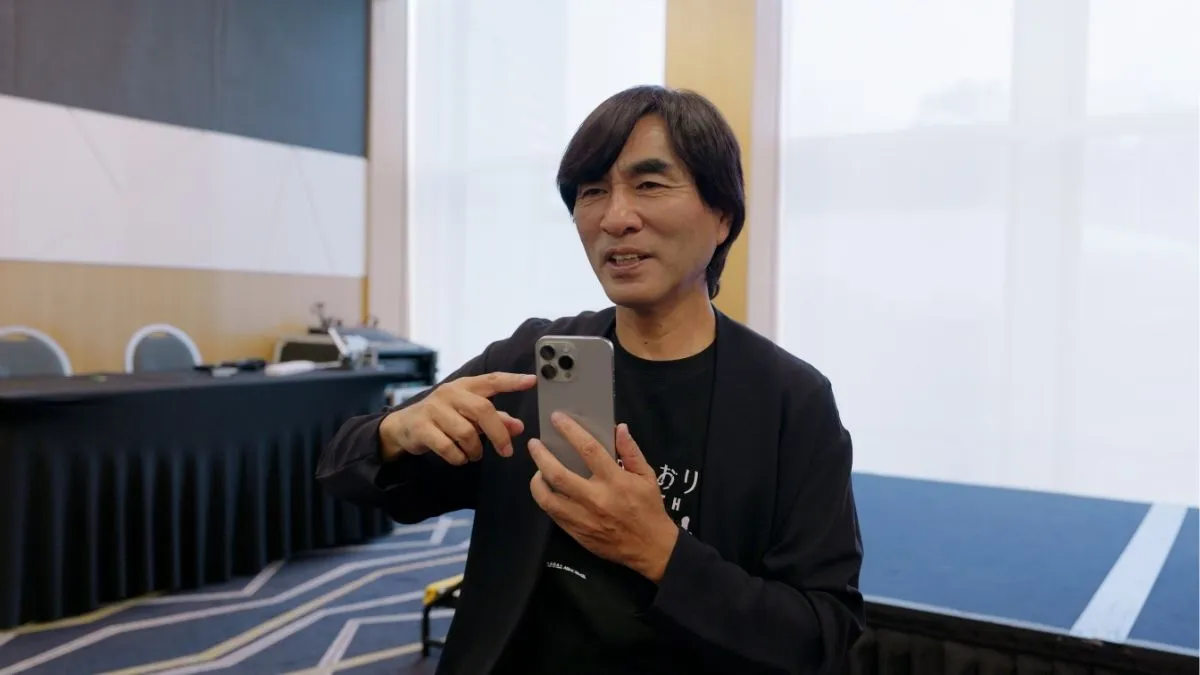
But Kawamori didn’t want the story to only focus on the “good and bad” of smartphones. “If I said ‘it’s good’ or ‘it’s bad’,” he stated, “it would turn into an argument of whether we need smartphones or not–but that’s not the point.”
To Kawamori, Labyrinth is not meant to be a cautionary tale, but as a showing of a new kind of relationship between humanity and technology.
“I want people to enjoy the convenience where it’s useful, but also to be careful where they need to be careful.”
The smartphone also strengthened the concept of duality in identity for Kawamori. Calling back to his previous statement about his connection to his smartphone, Kawamori reflected on how there are different versions of people that they present to others, even without the device.
“But once digital devices entered our lives, you could use apps to edit or transform yourself far beyond what’s naturally possible,” he explained, “when that happens you may gradually lose sight of who you are.”
Kawamori admitted that people who are more attuned to their devices may be able to navigate this reality better, but to him, he felt like it might be “pushing the biological limits of what humans can balance.”
“That’s why I wanted audiences to think, even briefly: ‘What kind of person am I?’ ‘What do I really want to do?’”
This duality led to Kawamori's idea of a “labyrinth inside one's own heart”. In the film, Shiori grapples with an alternate self that takes her place in the real world, all the while finding a way to escape the maze that is alternate Yokohama. Kawamori likened her experiences as a focus on everyone, not just people the same age as her, and how the use of smartphones has affected them.
“How they expand our minds, the pressures they bring… I spent years thinking about these things, discussing them with the team. It became an opportunity to question: ‘What is my own individuality?’ ‘How should I express myself?’ 'How should I use my abilities?'”
Labyrinth may have stepped away from the rich portrayal of an expansive interstellar universe like in Macross, but Kawamori believes that a person's inner universe can be just as vast and as precious. To him, the heart is both a maze and an incredibly rich world, something he hopes that longtime fans and new viewers can understand through this upcoming feature film.
Labyrinth is set to premiere theatrically in Japan on 1 January 2026, while Abnormal Studios will be releasing the film in 12 territories: Malaysia, Brunei, Vietnam, Indonesia, Thailand, Philippines, Singapore, Cambodia, Myanmar, Laos, Australia, and New Zealand. Dates for these premieres are yet to be announced.
Additionally, the film is opening early in a Malaysia Fan Premiere on 21 December, 2025.
Shoji Kawamori directs the movie at SANZIGEN. Taichi Hashimoto writes the scripts while Risa Ebata designs the characters. The film’s additional production staff members are:
- Visual Supervisor: Risa Ebata
- Mechanical Design: Shoji Kawamori
- Chief Animation Director: Takuya Chanohara
- Production Design: Barnstorm Design Lab
- CG Supervisor: Naoya Okugawa
- Director of Photography: Shoko Hayashi
- Colour Design: Mana Watanabe
- Art Director: Itsuki Ooishi, Hiroshi Morikawa
- Editing: Hatsumi Hidaka
- Music: yonkey
- Sound Director: Fumiyuki Gou
- Sound Effects: Ryuuta Nakahara
- Sound Production: Bit grooove production
- Music Producer: Yoshiro Tamamura
- Animation Producer: Hiroaki Matsuura
- Work Producer: Shouta Hozumi
- Production: Tatsumi Yoda, Youko Matsuzaki
- Planning: Toshiaki Obata
- Producer: Toshiaki Obata, Masaki Terada, Kazuki Ooshima, Masako Iwamoto
The cast includes:
- Shiori Maezawa voiced by SUZUKA of ATARASHII GAKKO!
- Suguru Kagami voiced by Takuto Teranishi of timelesz
- Komori voiced by Taizō Harada
- Kirara Kurashina voiced by Aoi Itō
- Kento Yamada voiced by Jun Saitō
- Keizou Maezawa voiced by Show Hayami
- Yoriko Maezawa voiced by Maaya Sakamoto
- Tosaka voiced by Tomokazu Sugita
The opening theme song of the movie is ‘Sailor, Sail On’ performed by J-pop group ATARASHII GAKKO!'s SUZUKA.